


Join us on June 22 for a community screening and discussion about PFAS, the so-called “forever chemicals” affecting communities across the nation.
As concerns about drinking water quality continue to grow, communities across the United States are paying closer attention to a group of chemicals known as PFAS. These chemicals have become the focus of increasing scientific research, public health discussions, and regulatory action due to their persistence in the environment and potential impacts on human health.
To help our community better understand this important issue, the Southern Sustainability Institute, Athens Land Trust, and the Coalition of Athens Scientists are hosting a free public screening of the documentary Contaminated: The Carpet Industry’s Toxic Legacy followed by a community discussion about PFAS contamination and current efforts to regulate these chemicals.
Event Details
PFAS Community Screening & Discussion
📅 Date: June 22, 2026
🕕 Time: 6:00 PM
📍 Location: Athens-Clarke County Library Auditorium
Baxter Street, Athens, Georgia
The event is free and open to the public.
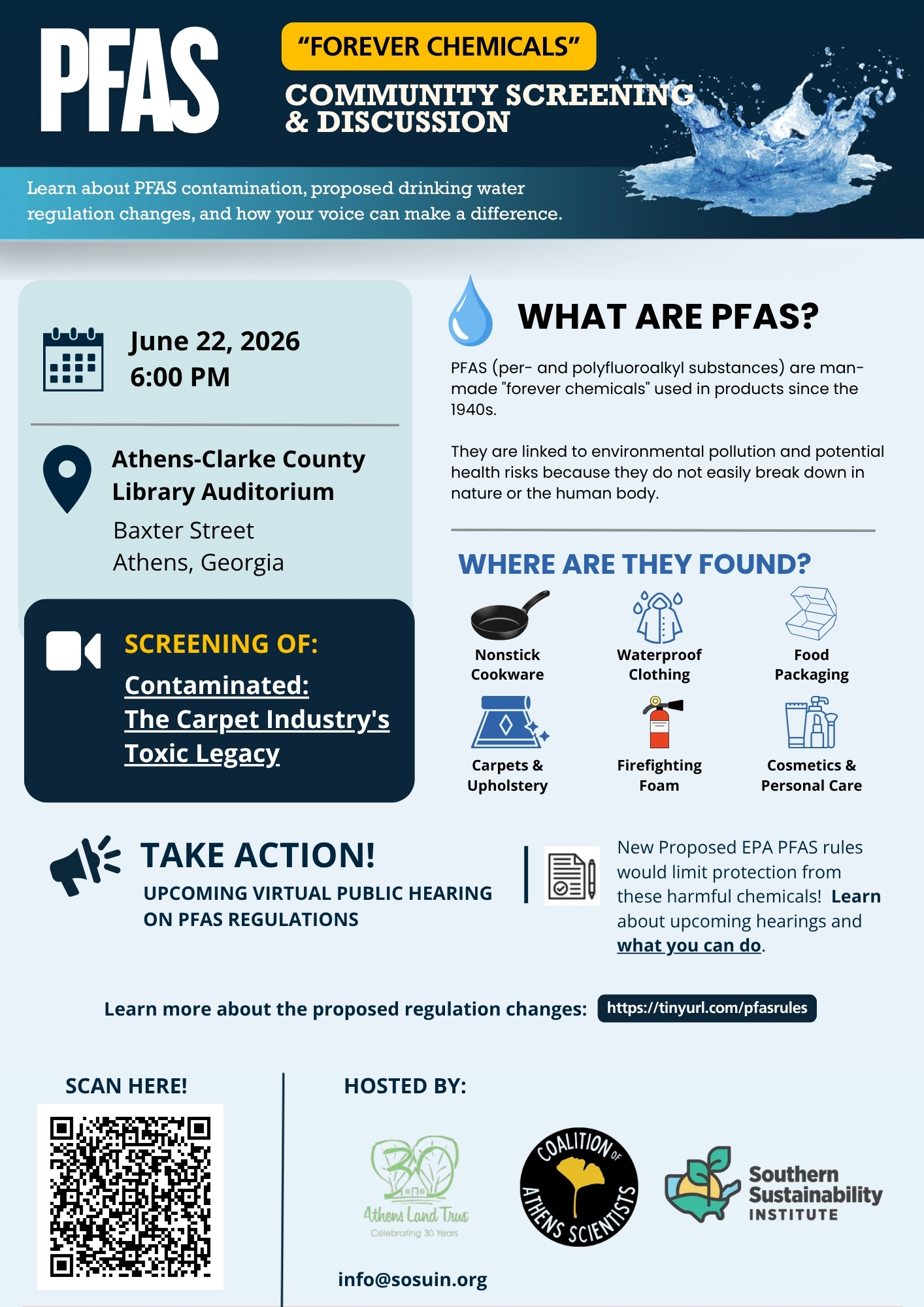
What Are PFAS?
PFAS stands for per- and polyfluoroalkyl substances, a large group of synthetic chemicals that have been used since the 1940s in thousands of consumer and industrial products.
These chemicals were developed because they are extremely effective at resisting water, grease, oil, and stains. As a result, PFAS have been widely used in products that many of us encounter every day.
Examples include:
- Nonstick cookware
- Waterproof clothing
- Stain-resistant carpets and upholstery
- Fast-food wrappers and food packaging
- Cosmetics and personal care products
- Firefighting foam used at airports and military facilities
Unfortunately, the same chemical properties that make PFAS useful also make them a growing environmental concern.
Why Are PFAS Called “Forever Chemicals”?
PFAS are often referred to as “forever chemicals” because they do not readily break down in the environment.
Most chemicals eventually degrade through exposure to sunlight, water, bacteria, or natural chemical reactions. PFAS are different. Their carbon-fluorine bonds are among the strongest chemical bonds known, allowing them to remain in soil, groundwater, rivers, lakes, and even the human body for years or decades.
Scientists have found PFAS contamination across the globe, from urban areas to remote wilderness regions. Studies have also detected PFAS in the blood of the vast majority of Americans.
Because these chemicals accumulate over time, even small exposures can become significant over the course of a lifetime.
Health Concerns Associated with PFAS
Research into PFAS exposure is ongoing, but scientific studies have linked certain PFAS compounds to a variety of health concerns.
Potential health effects include:
- Increased cholesterol levels
- Reduced immune system response
- Developmental effects in infants and children
- Hormonal and endocrine disruptions
- Increased risk of certain cancers
- Liver and kidney impacts
While scientists continue to study the full extent of these risks, there is broad agreement among public health experts that reducing PFAS exposure is an important goal.
Why This Matters in Georgia
PFAS contamination is not just a national issue—it affects communities throughout Georgia and the Southeast.
Industrial facilities, landfills, wastewater treatment systems, military installations, and manufacturing operations can all contribute to PFAS contamination in water supplies.
Georgia residents increasingly want to know:
- Is PFAS present in local drinking water?
- How are water systems being monitored?
- What regulations are being proposed?
- How can citizens participate in decision-making processes?
These are some of the questions that will be explored during the June 22 event.
Documentary Screening: Contaminated: The Carpet Industry’s Toxic Legacy
The featured documentary examines the role of PFAS in the carpet manufacturing industry and the lasting impacts these chemicals have had on workers, communities, and the environment.
The film highlights stories from affected communities while exploring the broader challenge of managing PFAS contamination nationwide.
Following the screening, attendees will have an opportunity to discuss what they learned and ask questions about PFAS, drinking water protections, and community action.
Proposed Changes to PFAS Drinking Water Regulations
The timing of this event is especially important because federal regulators are currently considering changes related to PFAS drinking water standards.
Community members will learn about an upcoming virtual public hearing that provides citizens with an opportunity to share their perspectives on proposed regulatory changes.
Upcoming Public Hearing
📅 July 7, 2026
🕚 Public comment opportunities available from 11:00 AM to 7:00 PM
Public participation plays a critical role in environmental decision-making. Whether you support stronger protections, want to learn more about the issue, or simply want your concerns heard, the hearing offers an opportunity to engage in the process.
Registration information will be available during the event.
Why Community Education Matters
Environmental challenges can often feel overwhelming, especially when they involve complex scientific and regulatory issues.
Community events like this help bridge the gap between scientific research and public understanding. By learning more about PFAS contamination, residents can make informed decisions, ask meaningful questions, and participate in conversations that affect the future of their communities.
Knowledge is one of the most powerful tools available for protecting public health and the environment.
Join the Conversation
Whether you are a student, educator, environmental advocate, parent, healthcare professional, or simply a concerned citizen, we invite you to attend this free community event.
Together, we can better understand the challenges posed by PFAS contamination, learn about proposed drinking water regulations, and explore ways to make our voices heard.
Event at a Glance
PFAS Community Screening & Discussion
Featuring: Contaminated: The Carpet Industry’s Toxic Legacy
Date: June 22, 2026
Time: 6:00 PM
Location: Athens-Clarke County Library Auditorium, Baxter Street, Athens, Georgia
Admission: Free and Open to the Public
Hosted by:
- Athens Land Trust
- Coalition of Athens Scientists
- Southern Sustainability Institute
For more information, contact:
info@sosuin.org
Resources
PFAS Information
- U.S. Environmental Protection Agency (EPA) – PFAS Explained: https://www.epa.gov/pfas/pfas-explained
- Agency for Toxic Substances and Disease Registry (ATSDR) – PFAS and Your Health: https://www.atsdr.cdc.gov/pfas
- Environmental Working Group (EWG) – PFAS Resources: https://www.ewg.org/areas-focus/toxic-chemicals/pfas-chemicals
Public Hearing Information
- Registration for the July 7 Public Hearing: https://www.eventbrite.com/e/public-hearing-for-proposed-regulations-related-to-pfas-in-drinking-water-tickets-1988851418130
Information on Proposed Regulatory Changes
- Southern Environmental Law Center (SELC): https://www.selc.org/press-release/epa-proposes-to-gut-limits-on-toxic-pfas-in-drinking-water-abandoning-communities-across-the-country/
